Oslo Philharmonic Memories
Before talking about my free-lance orchestral career (other than the DMMO, which I have just concluded a series of blogposts), an event occurred that brought to mind further memories of my time with the Oslo Philharmonic Orchestra. I know that I have posted quite a bit already about my fifteen years with the orchestra, but not everything got into the reporting, which maybe is a good thing, as it leaves something for this particular blogpost.
It is almost twenty-eight years since I left my position with the Oslo Philharmonic, and I can hardly believe how much time has passed. It seems like only yesterday that I played my last concert with the orchestra, a performance of Bruckner’s mighty Eighth Symphony, with Heinz Wallberg conducting. It was a fine performance and a good way to go out – on a high note, with one of my favorite pieces.
More about this concert and memory later.
I mentioned earlier that there was an event that triggered my memories of tenure in Oslo, many of which I had not written down. It was not a bad event, simply a retirement. In this case, it was the retirement from the post of principal percussionist (or solo slagverker as the position is called in Norwegian) of my good friend and former colleague, Christian Berg. It was a bit of a shock in the sense that after nearly thirty-seven years in that position, I was beginning to think that he’d be there forever! I was in my sixth season when he first auditioned for the position, back in 1988, and again when he eventually joined up after touring with us in the spring season 1989. More about this later, and I will have a lot to say about my professional relationship with Christian later in this post.
The most important memories have to do with the people I have worked with. I need to start with my colleagues of the percussion section. These are the people I worked very closely for fifteen years, and while I have mentioned them several times in previous blog posts, they deserve mentioning here as there are many things that I have left unsaid. All of them good, I hasten to add.
Per Erik Thorsen
I will start with Per Erik, as he was the principal percussionist of the orchestra when I took my ten-week on-the-job audition in the late fall of 1982 and early winter of 1983, and remained in that position officially until 1989. He stepped back into the section as a section percussionist until his retirement from the orchestra in early 1999, some seven months after my own departure. He passed away on May 25, 2022.
He was well-known in Norwegian musical circles, and some have even called him “The Father of Modern Norwegian Percussion”. As an orchestral musician, chamber musician, and teacher, he was also well known in the Norwegian jazz scene, being a member of a Dixieland band.
He was on the faculties of the East Norway Music Conservatory throughout his career, and also the Norwegian Music Academy (from its founding in 1973).
When I arrived on the scene in 1982 -1983 for my trial period with the orchestra, Per Erik was extremely gracious, and took time to get me acclimated to the area. I spent a lovely weekend at his home and both he and his wife Margit could not have been more gracious. After I was hired, he continued to be of great assistance, even helping me with my beginning attempts at learning the Norwegian language. I remember sitting with him during the bus ride to Gothenburg, Sweden during my first tour with the orchestra. That was in the fall of 1983. It was a two-and-a-half-hour bus ride, and he was kind enough to spend it teaching the singular and plural cases. (One cow, many cows – En ku, flere kuer) We gradually worked together and developed a good professional working relationship, However, the fact that he was seventeen years older than I meant that, in addition to the natural reserve that Norwegians were noted for there was a certain maturity about him, and I am still not sure if he ever got totally used to me, but we did work well together. We always laughed together over the Norwegian lessons, and I always greeted him each day with the typical Norwegian greeting “Hvordan har du det? And he would always answer with either “Slett ikke verst” or “Slengede vinkel”(“Not too bad” or “Slightly out of kilter”). He could be a bit of a tease under the right circumstances. I was twenty-nine when I arrived in Oslo for the ten-week trial period, which ended in March of 1983. I was hired in July and took up the position in early September, and Per Erik and I had a joint solo opportunity when we performed together with a performance of the orchestral version of Bartok’s Sonata for Two Pianos and Percussion later that season. We got to know each other musically during our many rehearsals together.
Per Erik was an excellent all-around percussionist, although I think his specialty was the snare drum. He was phenomenal. He used the traditional grip and was fond of the Ludwig Super-Sensitive line of snare drums. People would always talk about his control in “Bolero”. After 1989, he stepped back into the section and demonstrated his expertise on the bass drum. One could always rely on him for a totally professional performance.
Trygve Wefring
Trygve was my assistant timpanist from the beginning of my tenure until my departure and remained in that position (which was re-designated co-principal timpanist (alternerende solopaukist) about five years before I left) until his retirement in 2006. Born in Os in Hordaland, Norway, he was definitely a character!
With his basically cheerful temperament and his delightful West Norway accent, he was fun to be with. He was another excellent colleague who was highly skilled on just about all of the percussion instruments, with focus on timpani and the mallet instruments, although he was one heck of a tambourine player as well. Prior to joining the orchestra in 1979, he was timpanist of the Trondheim Symphony as well as percussionist and assistant timpanist in the Norwegian Opera Orchestra, with a short stint as timpanist of the Norwegian Radio Orchestra. He was an active participant in the contemporary music scene in Norway, being a regular member of the New Music Ensemble from its founding in 1976 until it was disbanded in 1988. To watch him play contemporary percussion parts was amazing – he practiced hard behind the scenes, but when it came to delivering the goods in performance, he brought it off with aplomb – making it look easy, which it was not. Being from the county of Nordland, which counts Bergen as its county seat, he was and is an avid fisherman and was quite a good boat handler. Like Per Erik, he was an excellent host. I visited with him and his family for the first time during my trial period, It was my first trip to Drøbak, which is about 18 miles south of Oslo, right on the Oslofjord. He and his wife Eva showed me wonderful hospitality, and we had a great visit. He was particularly proud of his boat, and if it hadn’t been in the beginning of winter, I probably would have been taken for a short sail!
Being my assistant timpanist, Trygve and I had by necessity a slightly closer working relationship than with Per Erik and the other percussionists, although I made sure to not neglect my responsibilities towards them. It was a tribute to Trygve’s character that he was as good an assistant and later co-principal as he was, and he was very, very good. He took the audition for the timpanist position and from what I understand, was the first on the list. The chief conductor at that time, Mariss Jansons, wanted an international player in that position, as he was in the midst of orchestra-building, and that was the way the orchestra was going, so, perhaps unfairly, Trygve was passed over. I felt bad for him at the time (and we later discussed it, and he was able to get it off his chest). He never openly said anything about it, so I had taken him aside and kind of forced it out in the open. After that, we worked thing s out that he eventually got promoted to co-principal timpanist. I was one hundred percent behind him for that, and both of us were better off for it.
I had better explain a bit about the position of co-principal timpanist. It didn’t really exist in Norway as it does today when I arrived in Oslo. Trygve’s position in the orchestra when he was hired in 1979 was as third percussionist, with the additional assignment of assistant timpanist. It meant basically that when there was a second timpani part, as in the Mahler symphonies, Stravinsky’s Le Sacre du Printemps, Schoenberg’s Gurrelieder, Holst’s Planets, etc, Trygve would automatically play that part, and someone would fill in for him in the percussion section. Occasionally, if my predecessor, Knut Fjelhøi, needed a week off, Trygve would fill in for him, or play an occasional overture or concerto on a concert. Nothing like the position of co-principal timpanist that they have in the German orchestras such as the Berlin Philharmonic or the Bavarian Radio Symphony, or many of the opera orchestras. In the USA, if I am not mistaken, other than the Metropolitan Opera, which has had two principal timpanists for many years now, this position is the exception rather than the rule. One principal timpanist – one assistant timpanist.
Needless to say, without taking into account the disappointment felt by my colleague as well as the blow to national pride by having an outsider take over what was a prime position in what became Norway’s national orchestra over time, I walked into a situation that could have blown up in my face, if my colleagues chose to make it that way. To Trygve’s great credit and to that of the rest of the percussion section, they put aside any reservations they may have had and welcomed me warmly.
Once I passed my six-month probation, I was confirmed in my position, and once that was done, Trygve and I began our discussions that over time resulted in a position of “alternerende-solo-paukist”, or literally alternating -solo-timpanist. It was more than an assistant’s position, with my friend Tryggve getting up to 30 percent of the timpani work during the season, in addition to his responsibilities to play second timpani. He and I managed to cobble this together and the administration made it official. Up until this point Trygve was functioning and being paid as assistant principal percussionist. With the creation of this new role, he would become the alternating-solo-timpanist and step back into the section as third and later fourth percussionist when they expanded the section.
It was a solution that worked well, as there was a lot of good will on all sides.
At first, coming from a musical culture in which it was “one timpanist – one -assistant” mode of operation – it first struck me as if I was getting the short end of the stick, but as time passed, and after several discussions with other colleagues in the orchestra, I was actually getting some time off now and then to practice and develop my skills without the constant pressure of day-in and day out rehearsals and concerts. It left me with time to practice the Norwegian contemporary repertory which could be complicated. I was a better player for it, and it also benefitted Trygve, as he played many works that he normally would not have had the opportunity to play otherwise.
During the course of my last season, I switched roles with him and played second timpani in Mahler’s 1st and Shostakovich’s 4th Symphonies. I knew I was leaving at the end of the season, and there was still a lot of big works during those final few months. I knew he appreciated it and when the time came for me to move on, we had built a good friendship as well as a great professional relationship. He was actually sorry to see me go, as I was sad to be taking my leave of my colleagues.
Christian Berg
I now come to my memories of working with Christian, whose recent retirement precipitated this blogpost. . I first met Christian early on in my tenure. This would have to have been in the spring of 1984 or thereabouts. The orchestra had a series of Family Concerts, each series of which consisted of two rehearsals and a concert on Saturday afternoon at 1:00 p.m. local time. This particular series was conducted by Esa-Pekka Salonen, who was at the outset of his phenomenal career. He was about twenty-eight and was soon to be our principal guest conductor. On the program was Bernstein’s Symphonic Dances from West Side Story, which calls for a large percussion section. In addition to Per Erik Thorsen, Trygve Wefring, and Per Melsæter (our third percussionist at the time), Alan Suttee (formerly of the BBC symphony and at the time Instructor of Percussion at the Norwegian State Music Academy) and a youthful Christian Berg were among the extra percussionists. It was a fun program, and I got to admire Christian’s considerable skills for the first time. He was good. He played as an extra on several programs before becoming principal percussionist with the Trondheim Symphony Orchestra, a position he held from 1984 until 1989, when he joined the Oslo Philharmonic Orchestra.
I was always an admirer of Christian’s playing, particularly his cymbal work as well as his abilities on the snare drum. He was also a first-rate mallet player and skilled on the drum set as well. Per Melsæter, our third percussion and who was in line to succeed Per Erik Thorsen as principal percussion starting from the 1987-88 season, was one of Christian’s mentors and became a close friend and colleague. I also worked well with Per and counted him a very good friend and colleague, and when he died unexpectedly just before he was to take up his new position in July 1987, all of us were shocked. We grieved but had to carry on, and this meant new auditions, which were held during the following season for Per’s position. I believe we held the auditions in the spring of 1988, and it came down to Christian and a Swedish percussionist. The decision was a very close call – the percussionist from Sweden got the position (albeit on a probationary status) and he joined the orchestra that August. Christian resumed his duties in Trondheim for the time being. Every musician hired is (or was) given a six-month probationary period. The new percussionist was very talented and had a natural touch for just about all the percussion instruments, but he turned out to have non-musical issues that kept those of us in the timpani/percussion sections from giving him the final stamp of approval. These were serious enough for us to re-evaluate or original decision to recommend him for the job. The Trondheim Symphony gave a concert in Oslo in early December of 1988, and both Trygve and I attended the concert. One of my students (and later immediate successor), Rolf Cato Raade, was the timpanist, and Christian was on stage as principal percussionist. I believe the work they were performing was Johann Halvorsen’s First Symphony, and when Christian picked up the cymbals and played, I had a revelation. The sound was so good and right – that I knew at that moment that he was the possible solution to our percussionist problem. When I met Trygve at the end of the concert, from the look on his face when we met, I could tell he was thinking the exact same thing! He confirmed it when he told me that Per Erik felt the same way, and the upshot was that the new percussionist did not pass his probation, and the since Christian was the next on the list of possible hires, he was offered a six-week period with the orchestra in early 1989, which included a recording for EMI and a tour of Germany and Austria.
I count that period in February 1989 as the official start of our working relationship. It was a busy six-week period – what with the recording sessions for EMI, and the accompanying concerts as well as the aforementioned tour, there was a lot for him to do. On the recording schedule were three blockbuster works – Respighi’s Festa Romanae, Ravel’s Daphnis and Choe Suite No. 2, and Paul Dukas’ L’ Apprenti Sorcier”. In addition to Rachmaninov’s Second Piano Concerto and Sibelius’s First Symphony.
There was enough work for him to show his stuff, as well as enough coordinating the large percussion sections for the Respighi and Ravel to also show his skill in organizing the parts for these works.
He proved himself fully up to the task, and in addition to his musical duties, he arranged for a trip to the Kolberg Percussion Factory on one of our free days during to tour for the timpani and percussion section, which I have already reported on in an earlier post in detail. Suffice it to say that we not only gained a principal percussionist, but the orchestra gained some much-needed percussion equipment as a result of Christian’s trial period. It was a great relief when he was confirmed in his position and officially started on August 1, 1989.
We worked closely together, and we developed a close friendship over the nine seasons we worked together. There are so many memories – that first tour – and many more to come – as well as the rest of the EMI recordings and the Mahler Second, Symphony we performed and recorded for Chandos in November 1989 for the orchestra’s seventieth anniversary.
Here is a link to the 5th movement of our Mahler Second recording for Chandos below:
And here is the first movement of the Respighi Feste Romanae -“Circenses” which we recorded in February 1989, as part of Christian’s trial-period – it was exciting and fun to play:
And last but not least, is a photo of “The Gang” taken at Carnegie Hall in New York in 1991after an exciting performance of Shostakovich’s 7th Symphony.
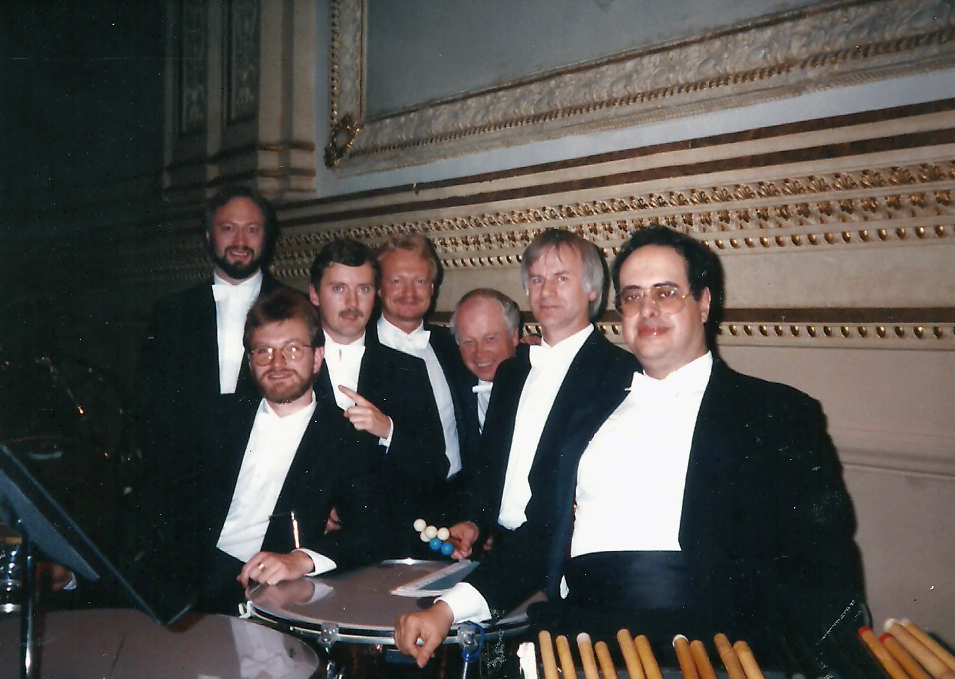
Right to left: Bjorn Loken, Christian Berg, Einar Fjaervoll, Morten Belstad, Per Erik Thorsen, Trygve Wefring, and yours’s truly!
What a great group of friends and colleagues!
Recent Comments