The DMMO Years
The Stars of Tomorrow Concerts 1998 – 2016
This will be a relatively short blog post compared to my previous ones. I am sort of closing out the account of my career with the Des Moines Metro Opera, which covered the summers of 1998 through 2016. I am going to cover in more detail one of what became a regular feature of the summer festival season – namely, what started out being called “The Apprentice Artist Concert”, and is today called “The Stars of Tomorrow” concert.
The format of the event has basically remained the same since its inception as part of the 1998 Summer Festival. It was, and is, basically a chance for artist apprentices to “strut their stuff” onstage – doing unstaged scenes from various operas, this time with orchestral accompaniment, and in formal attire.
During each season, the apprentices, who audition for a position as an artist apprentice in the winter prior to the upcoming summer festival, gather together in Indianola about the last week in May and get down to business. Each apprentice artist serves as a member of the chorus in productions requiring it, of which there are quite a few. During my nineteen seasons with the company, most of those seasons always had productions requiring a chorus for at least two and sometimes all three mainstage productions! Apart from that, each apprentice artist is coached in various roles throughout the summer festival and there are at least six semi-staged performances with piano accompaniment, which gives them a chance to put what they are learning and have learned into practice.
In addition, certain apprentices serve as backups for the principal artists in case of illness or indisposition.
It is quite an honor for each singer to win a spot as one of the apprentice artists, and each one works very hard to succeed. One of the highlights of each season (at least for me) was to hear the apprentices as a chorus singing the hearts out at the first orchestral rehearsals of each production in the theater lobby. The rich, powerful voices combined with the phenomenal operatic repertoire – and being a part of all this – still gives me goose bumps to this day, nearly ten years after retiring from the scene.
The Actual Concert
The actual concert with orchestra is usually held towards the very end of the summer festival. Originally called the “Apprentice Artist Concert”, the name of the event was changed to “The Stars of Tomorrow Concert”. These were (and are) held off campus. The venue was always the Sheslow Auditorium at Drake University in Des Moines. During my tenure with the company, the concert was held on the last Thursday before the end of the festival. The auditorium is about the size of a small church, although wider, and has a large balcony. The stage is adequate for these performances, but while wide, it is not very deep. Acoustics are extremely live, so one has to be careful with dynamics. We were only able to use a reduced orchestra for these concerts; the orchestra was about thirty-five, using only three horns, two trumpets, two trombones, timpani and one percussion, plus a reduced string section, harp and the usual woodwinds.
The concerts usually started with an operatic overture – usually one that could best be performed with a reduced orchestra – for example, Mozart’s Overture to Le Nozze di Figaro, or Rossini’s Overture to Il Barbiere di Siviglia. This would be followed by scenes from various operas that the apprentice artists had been working on throughout the season, and this was their chance to shine. (NB! Earlier, I had mentioned that these were semi-staged. There was no possibility of this happening on the stage at Sheslow, so only the stage movements were performed as far as it was possible. The semi-staging took place on the weekly concerts with piano back in Indianola.) The conductors for this event were several. These were usually the assistant conductors for the various mainstage productions, who were also coaching the apprentice artists. One of them would conduct the overture, the others would conduct a scene or two. During much of my tenure, the founding artistic director, Dr. Robert L. Larsen, would conduct the final scene, which involved all of the artists, and it was always “Bevo al tuo fresco sorriso” from La Rondine, which was a great favorite of his. It was a great way to conclude the concert – with the soloists on stage, and all the other apprentice artists providing the choral parts from either side of the orchestra. It was always a very powerful moment, with all those voices at full blast! The apprentice artists sang their hearts out every time! The concerts began with the 1998 Summer Festival, and with the exception of the 2002 Summer Festival, have been ongoing to this day.
For almost all of my tenure, Dr. Larson acted as Master of Ceremonies as well as conducting the final scene. Dressed in his signature ice-cream colored suit, he always presided over the event with a deftness and affection for his singers. When he retired in 2010, he limited his appearances to acting as Master of Ceremonies, leaving the conducting of the final scene to his successor as Music Director, David Neely. By 2016, he had retired from that role as well, although if memory serves me well, he did conduct the scene from La Rondine one last time. I think it may have been my last season, 2016.
Here is the scene from “La Rondine” – “Bevo al tuo sorisso”. Just listening to it brings back memories, and even goose bumps!
I enjoyed the concerts very much, especially towards the end of my tenure, when I was allowed to have my own instruments carted up to Drake University for the event. For the first few seasons, with the exception of 2002, when we did not do the concert, I had to rely on the instruments from Drake University and had to go get them myself and have them schlepped over to the auditorium. Luckily, the music building was across the street from Sheslow Auditorium, but I still had to go down deep in the music building, pick out two timpani – the middle pair – and make sure they were in passable shape for the concert – and walk them across the street to the auditorium and put them back after the concert. Mark was always a great help, but I am sure that he was relieved as I was when we were finally able to take our own equipment from Indianola.
From about the fifth season onward, Mark and I settled into a routine which scarcely varied for the remainder of my tenure. As the sound check rehearsal and concert took place in the late afternoon and early evening of concert day, Mark and got to the Pote Theater around 10:00 a.m. on the morning of the concert day. With the help of the theater staff (some of whom were available, more or less), the pit wall was opened up, and we took out the needed percussion and timpani, and loaded it all into our transportation. In Mark’s case. it was the large company van, and in my case, it was my personal van. Due to the size of the stage at Sheslow Auditorium, I was restricted to the two middle timpani – sizes 26″ and 29″. Mark was making many trips back and forth as he was Personnel Manager as well as principal percussionist, so he headed up to Des Moines right away, while I had the rest of the morning and early afternoon free. I would usually dress for the event around two o’clock and then drive up to the venue about three o’clock. I got there about three-thirty, and was able to offload the instruments, stool and stick bag, then park the van not far away from the venue.
Once I settled in – by that, I mean getting the drums into position and the heads adjusted to the venue – a little more difficult as the concert took place during the height of the summer. The temperatures were reaching 95 degrees at noon – and the auditorium was air-conditioned, and it was running full blast. This meant that the drums needed about an hour to settle in. Once that was done, we had a run-through as a sound check. The concert started at 7:00 pm and ended at about 8:45 pm. They were all great fun, and the load out was surprisingly quick. I was able to get loaded out and on my back by 9:20 pm, and back to Indianola by 9:55 pm – and this was after a quick stop for a sub sandwich and soda! On the Friday medorning after the concert, Mark and I met at the theater and loaded our instruments back into the pit. We had to be quick, as we usually had an opera that evening.
Final Thoughts
These concerts were always fun – the apprentice artists were on top of the game, and the orchestra members were also well-prepared. There were no bad performances, and it was great to see the artist apprentices put their best foot forward and give it their all! It was good for the orchestra to get out of the pit and play in an acoustic that had decent acoustics – even though they were very “lively”. I always had to play one dynamic or more less as not to drown out the orchestra and singers. I used my Carlisle “Mozart “mallets and mallets with a medium hard head in order to get the articulation. It worked well. For some of the seasons, I used the Light timpani, but for the last several seasons, the middle two Yamaha 6000s were used, and they did well.
I had my ups and downs with the extra preparations for transportation of the instruments from Indianola to Des Moines and back, but after I had done it for a couple of times, I got used to it and actually looked forward to it. It was an honor to be a member of the DMMO for as long as I was, and this was a part of the festival that I came to look forward to.
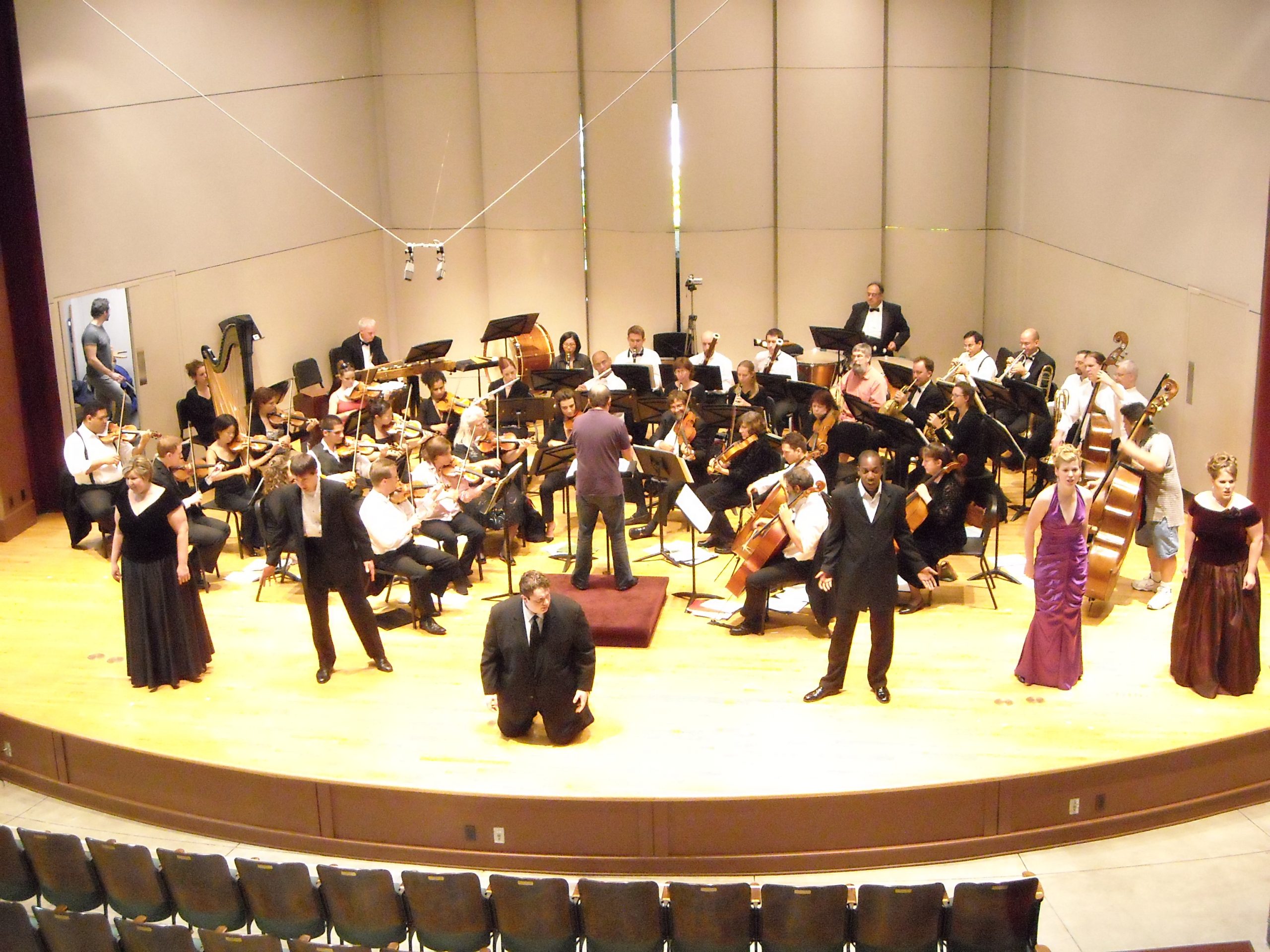
Here is a photo of the final rehearsal from the 2008 “Stars of Tomorrow” concert:
Recent Comments